Resources
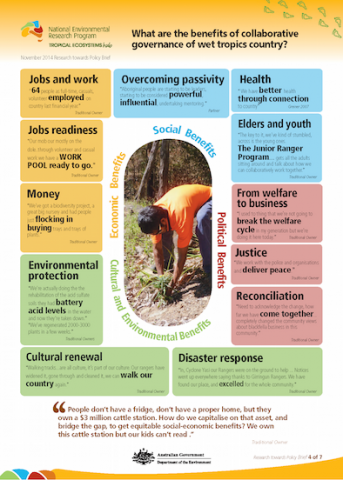 Hill, R. (2014) What are the benefits of collaborative governance of wet tropics country?
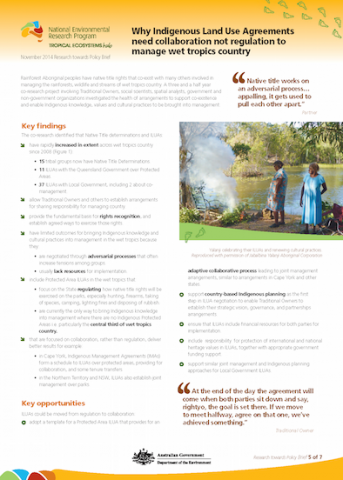 Hill, R. (2014) Why Indigenous Land Use Agreements need collaboration not regulation to manage wet tropics country.
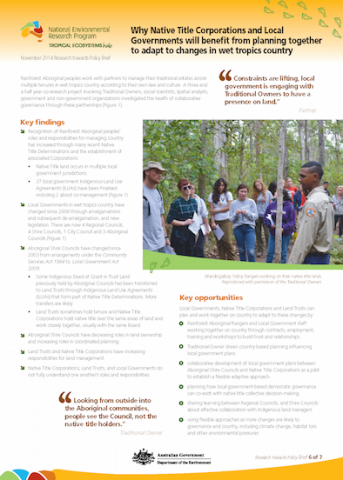 Why Native Title Corporations and Local Governments will benefit from planning together to adapt to changes in wet tropics country.
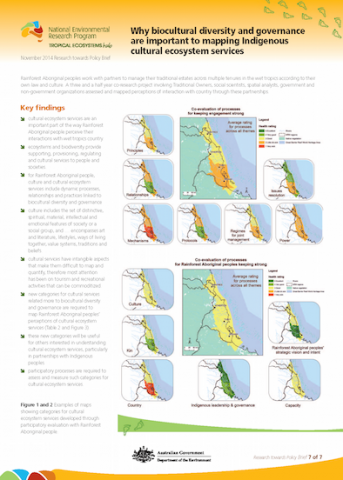
Hill, R (2014) Why biocultural diversity and governance are important to mapping Indigenous cultural ecosystem services.
 Maclean, K. Hill, R., Pert, P.L. (2015) Desktop review of co-management pathways in Cape York Peninsula. An assessment of support for structures, processes and results that enable Aboriginal Peoples and their partners to work towards co-management of country.
© CSIRO

Cullen-Unsworth, L.C., Hill, R., Butler, J.R.A., Wallace, M. (2012) A research process for integrating Indigenous and scientific knowledge in cultural landscapes: principles and determinants of success in the Wet Tropics World Heritage Area, Australia. The Geographical Journal. 178 (4), 351-365 [doi:10.1111/j.1475-4959.2011.00451].
Hill, R., Grant, C., George, M., Robinson, C.J., Jackson, S., Abel, N. (2012) A typology of Indigenous engagement in Australian environmental management: Implications for knowledge integration and social-ecological system sustainability. Ecology and Society. 17 (1), 23 [doi:10.5751/ES-04587-170123].
* Funded by DEWHA (MTSRF)
The International Journal of Science in Society
Cullen-Unsworth, L.C., Hill, R., Butler, J.R.A., Wallace, M. (2012) Development of Linked Cultural and Biophysical Indicators for the Wet Tropics World Heritage Area. The International Journal of Science in Society. 2 (4), 181-194.
International Journal of Heritage Studies
Hill, R., Cullen-Hunsworth, L.C., Talbot, L.D., McIntyre-Tamwoy, S. (2011) Empowering Indigenous peoples' biocultural diversity through world heritage cultural landscapes: A case study from the Australian tropical forests. International Journal of Heritage Studies. 17 (6), 571-591 [doi:10.1080/13527258.2011.618252].
* Funded by DEWHA (MTSRF)
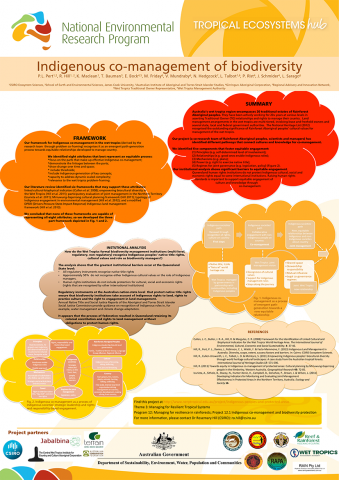 Indigenous co-management of biodiversity.