Resources
Meyer Steiger, D., Johnson, P., Hilbert, D., Ritchie, S., Jones, D., Laurance, S.G.W. (2012) Effects of landscape disturbance on mosquito community composition in tropical Australia. Journal of Vector Ecology. 37, 69-76 [doi:10.1111/j.1948-7134.2012.00201].
Meyer Steiger, D.B., Ritchie, S.A., Laurance, S.G.W. (2014) Overcoming the Challenges of Mosquito (Diptera: Culicidae) Sampling in Remote Localities: A Comparison of CO2 Attractants on Mosquito Communities in Three Tropical Forest Habitats. BioOne. 51 (1), 39-45 [doi:10.1603/ME12216].
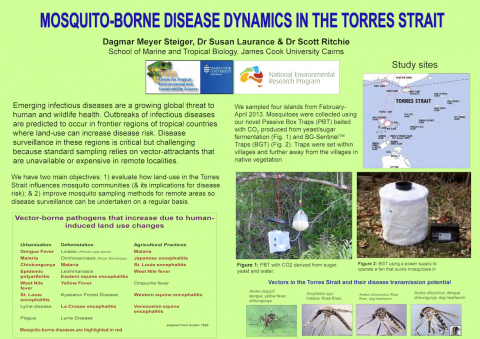 Mosquito-borne disease dynamics in the Torres Strait.

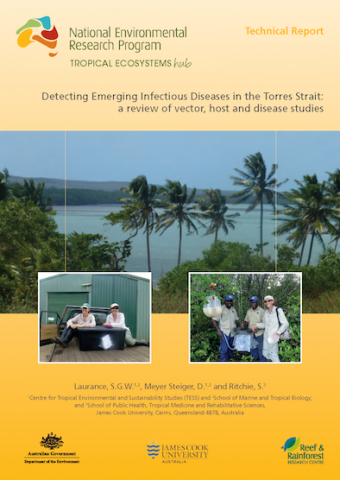 Laurance, S.G.W., Meyer Steiger, D., Ritchie, S. (2014) Detecting Emerging Infectious Diseases in the Torres Strait: a review of vector, host and disease studies.
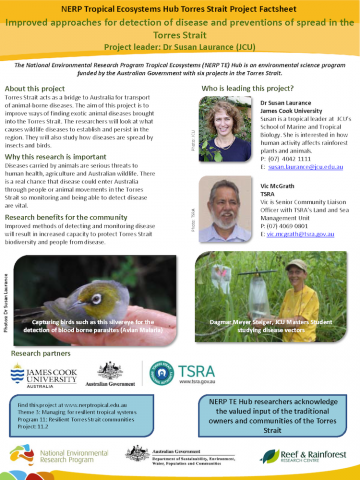 About this project:
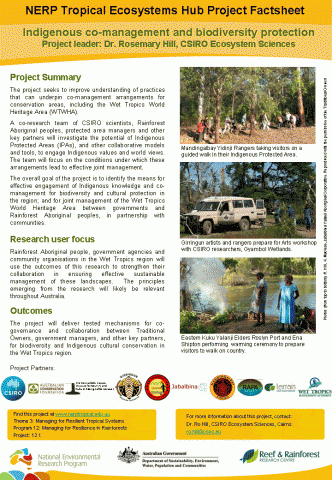 The project seeks to improve understanding of practices that can underpin co-management arrangements for conservation areas, including the Wet Tropics World Heritage Area (WTWHA).
A co-research team of CSIRO scientists, Rainforest Aboriginal peoples, protected area managers and other key partners will investigate the potential of Indigenous Protected Areas (IPAs), and other collaborative models and tools, to engage Indigenous values and world views. The team will focus on the conditions under which these arrangements lead to effective joint management.
The overall goal of the project is to identify the means for effective engagement of Indigenous knowledge and co-management for biodiversity and cultural protection in the region; and for joint management of the Wet Tropics World Heritage Area between governments and Rainforest Aboriginal peoples, in partnership with communities.
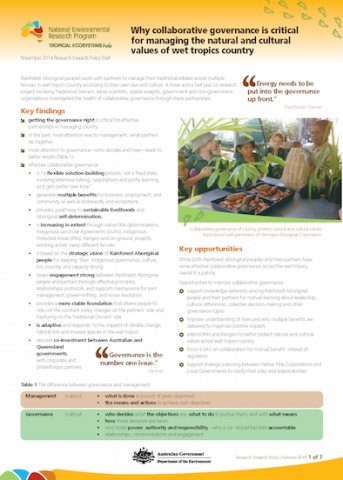 Hill, R. (2014) Why collaborative governance is critical for managing the natural and cultural values of wet tropics country.
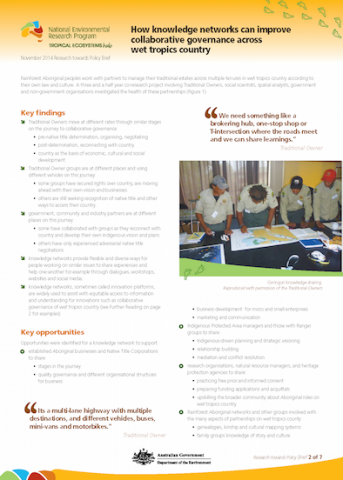 Hill, R. (2014) How knowledge networks can improve collaborative governance across wet tropics country.
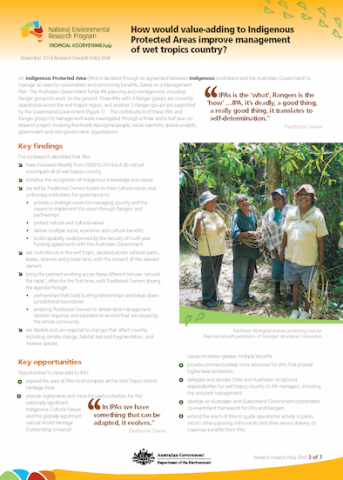 Hill, R. (2014) How would value-adding to Indigenous Protected Areas improve management of wet tropics country?
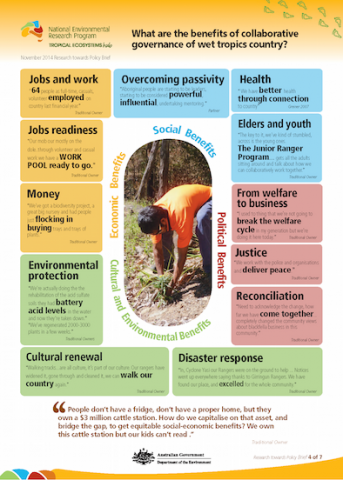 Hill, R. (2014) What are the benefits of collaborative governance of wet tropics country?
Pages
Latest News
- Laws protecting the Great Barrier Reef to be introduced next week, Queensland Premier says - Thu 28th May 2015
- Let’s get serious about protecting wildlife in a warming world - Thu 28th May 2015
- We’ve only monitored a fraction of the Barrier Reef’s species - Thu 28th May 2015
- Great Barrier Reef: warmer waters helping coral-eating starfish thrive - Fri 13th Feb 2015
- You are what you eat—if you're a coral reef fish - Wed 17th Dec 2014

Current search
Search found 254 items
- [all items]