Resources


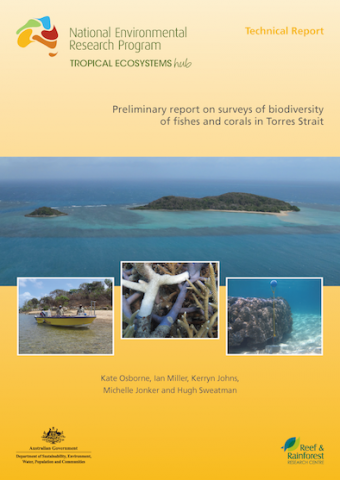
Osborne, K., Miller, I., Johns, K., Jonker, M., Sweatman, H. (2013) Preliminary report on surveys of biodiversity of fishes and corals in Torres Strait.
© Australian Institute of Marine Science (AIMS)
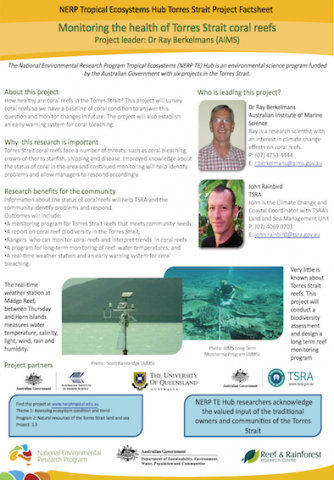 About this project:
What is the status of coral reefs in the Torres Strait? This project will survey coral reefs so we have a baseline of coral condition to answer this question and monitor changes in future.The project will also establish an early warning system for coral bleaching.
Find out more about Project 2.3

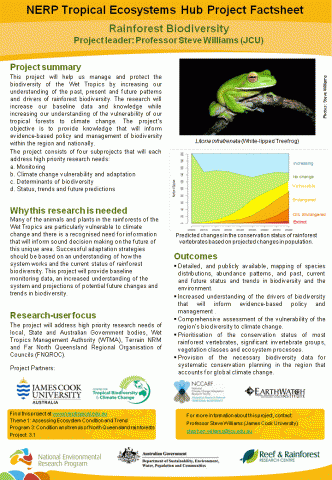 This project will help us manage and protect the biodiversity of the Wet Tropics by increasing our understanding of the past, present and future patterns and drivers of rainforest biodiversity. The research will increase our baseline data and knowledge while increasing our understanding of the vulnerability of our tropical forests to climate change. The project’s objective is to provide knowledge that will inform evidence-based policy and management of biodiversity within the region and nationally.
The project consists of four subprojects that will each address high priority research needs:
• Monitoring
• Climate change vulnerability and adaptation
• Determinants of biodiversity
• Status, trends and future predictions
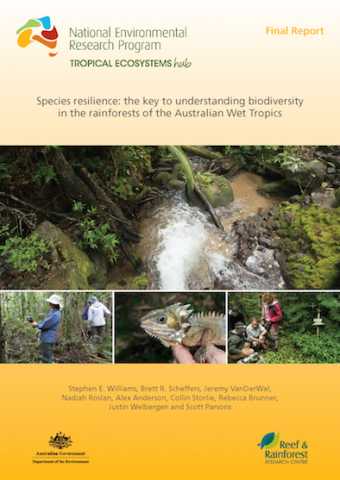 Williams, S.E., Scheffers, B.R., VanDerWal, J., Roslan, N., Anderson, A., Storlie, C., Brunner, R., Welbergen, J., Parsons, S. (2014) Species resilience: the key to understanding biodiversity in the rainforests of the Australian Wet Tropics.
© JCU
Memoirs of the Queensland Museum - Nature
Zozaya, M., Scheffers, B.R., Hoskin, C.J., MacDonald, S.L., Williams, S.E. (2013) A significant range extension for the Australian wet tropics skink Eulamprus frerei (Reptilia: Squamata: Scincidae). Memoirs of the Queensland Museum - Nature. 56 (2), 621-624.
Bateman, B.L., Murphy, H.T., Reside, A.E., Mokany, K., VanDerWal, J. (2013) Appropriateness of full-, partial- and no-dispersal scenarios in climate change impact modelling. Diversity and Distributions. 19 (10), 1224-1234 [doi:10.1111/ddi.12107].
Global Ecology and Conservation
Scheffers, B.R., Phillips, B.L., Shoo, L.P. (2014) Asplenium bird’s nest ferns in rainforest canopies are climate-contingent refuges for frogs. Global Ecology and Conservation. 2, 37-46 [doi: 10.1016/j.gecco.2014.06.004].
Bateman, B.L., VanDerWal, J., Williams, S.E., Johnson, C.N. (2012) Biotic interactions influence the projected distribution of a specialist mammal under climate change. Diversity and Distributions. 18 (9), 861-872 [doi:10.1111/j.1472-4642.2012.00922.x].
Reside, A.E., Welbergen, J.A., Phillips, B.L., Wardell-Johnson, G.W., Keppel, G., Ferrier, S., Williams, S.E., VanDerWal, J. (2014) Characteristics of climate change refugia for Australian biodiversity. Austral Ecology. [doi: 10.1111/aec.12146].
Pages
Latest News
- Laws protecting the Great Barrier Reef to be introduced next week, Queensland Premier says - Thu 28th May 2015
- Let’s get serious about protecting wildlife in a warming world - Thu 28th May 2015
- We’ve only monitored a fraction of the Barrier Reef’s species - Thu 28th May 2015
- Great Barrier Reef: warmer waters helping coral-eating starfish thrive - Fri 13th Feb 2015
- You are what you eat—if you're a coral reef fish - Wed 17th Dec 2014

Current search
Search found 254 items
- [all items]