Resources

McKeown, A., Westcott, D.A. (2012) Assessing the accuracy of small satellite transmitters on free-living flying-foxes: a case study for the use of satellite transmitters with active terrestrial animals. Austral Ecology. 37 (3), 295-301 [doi:10.1111/j.1442-9993.2011.02276.x].
Westcott, D.A., Fletcher, C.S., McKeown, A., Murphy, H.T. (2012) Assessment of monitoring power for highly mobile vertebrates. Ecological Applications. 22 (1), 374-383 [doi:10.1890/11-0132.1].
Mokany, K., Westcott, D.A., Prasad, S., Ford, A.J., Metcalfe, D.J. (2014) Identifying Priority Areas for Conservation and Management in Diverse Tropical Forests. PLoS ONE. 9(2) e89084 [doi:10.1371/journal.pone.0089084].
Mokany, K., Prasad, S., Westcott, D.A. (2014) Loss of frugivore seed dispersal services under climate change. Nature Communications. 5, 3971 [doi: 10.1038/ncomms4971].
Bradford MG, Westcott DA (2011). Predation of cassowary dispersed seeds: is the cassowary an effective disperser? Integrative Zoology 6: 168 - 177.
Supported by MTSRF funding.
Campbell, H.A., Dwyer, R.G., Fitzgibbons, S., Klein, C.J., Lauridsen, G., McKeown, A., Olsson, A., Sullivan, S., Watts, M.E., Westcott, D.A. (2012) Prioritising the protection of habitat utilised by southern cassowaries Casuarius casuarius johnsonii. Endangered Species Research. 17 (1), 53-61 [doi:10.3354/esr00397].
Beuttner, P.G., Westcott, D.A., Maclean, J., Brown, L., McKeown, A., Johnson, A., Wilson, K., Blair, D., Luly, J., Skerratt, L., Muller, R., Speare, R. (2013) Tick Paralysis in Spectacled Flying-Foxes (Pteropus conspicillatus) in North Queensland, Australia: Impact of a Ground-Dwelling Ectoparasite Finding an Arboreal Host. PLoS ONE. 8(9): e73078 [doi:10.1371/journal.pone.0073078].
Corlett, R.T., Westcott, D.A. (2013) Will plant movements keep up with climate change? Trends in Ecology & Evolution. 28 (8), 482-488 [doi:10.1016/j.tree.2013.04.003].
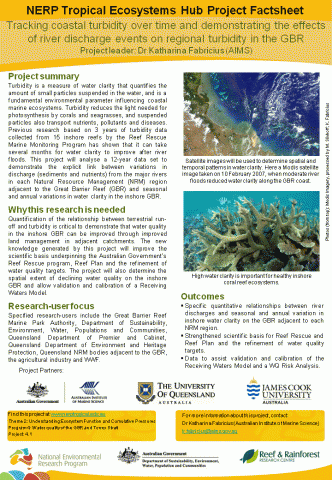 Turbidity is a measure of water clarity that quantifies the amount of small particles suspended in the water, and is a fundamental environmental parameter influencing coastal marine ecosystems. Turbidity reduces the light needed for photosynthesis by corals and seagrasses, and suspended particles also transport nutrients, pollutants and diseases. Previous research based on 3 years of turbidity data collected from 15 inshore reefs by the Reef Rescue Marine Monitoring Program has shown that it can take several months for water clarity to improve after river floods. This project will analyse a 12-year data set to demonstrate the explicit link between variations in discharge (sediments and nutrients) from the major rivers in each Natural Resource Management (NRM) region adjacent to the Great Barrier Reef (GBR) and seasonal and annual variations in water clarity in the inshore GBR.

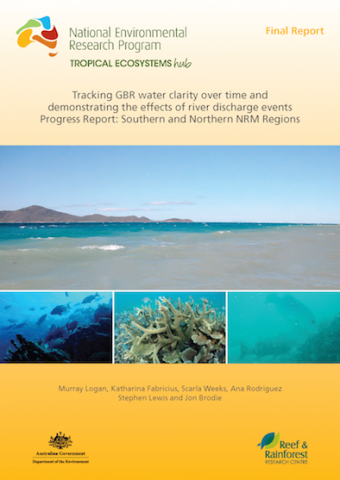 Logan, M., Fabricius, K., Weeks, S., Rodriguez, A., Lewis, S., Brodie, J. (2014) Tracking GBR water clarity over time and demonstrating the effects of river discharge events Progress Report: Southern and Northern NRM Regions.
© AIMS
Pages
Latest News
- Laws protecting the Great Barrier Reef to be introduced next week, Queensland Premier says - Thu 28th May 2015
- Let’s get serious about protecting wildlife in a warming world - Thu 28th May 2015
- We’ve only monitored a fraction of the Barrier Reef’s species - Thu 28th May 2015
- Great Barrier Reef: warmer waters helping coral-eating starfish thrive - Fri 13th Feb 2015
- You are what you eat—if you're a coral reef fish - Wed 17th Dec 2014

Current search
Search found 254 items
- [all items]