Resources

Lunt, I.D., Byrne, M., Hellmann, J.J., Mitchell, N.J., Garnett, S.T., Hayward, M.W., Martin, T.G., McDonald-Madden, E., Williams, S.E., Zander, K.K. (2012) Using assisted colonisation to conserve biodiversity and restore ecosystem function under climate change. Biological Conservation. 157, 172-177 [doi:10.1016/j.biocon.2012.08.034].

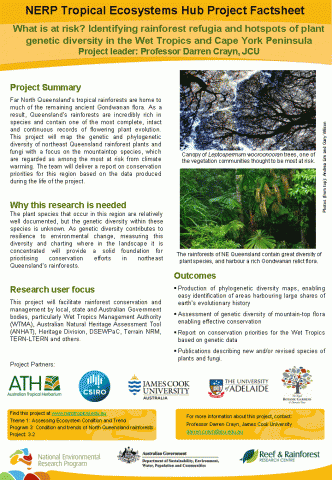 Far North Queensland’s tropical rainforests are home to much of the remaining ancient Gondwanan flora. As a result, Queensland’s rainforests are incredibly rich in species and contain one of the most complete, intact and continuous records of flowering plant evolution. This project will map the genetic and phylogenetic diversity of northeast Queensland rainforest plants and fungi with a focus on the mountaintop species, which are regarded as among the most at risk from climate warming. The team will deliver a report on conservation priorities for this region based on the data produced during the life of the project.

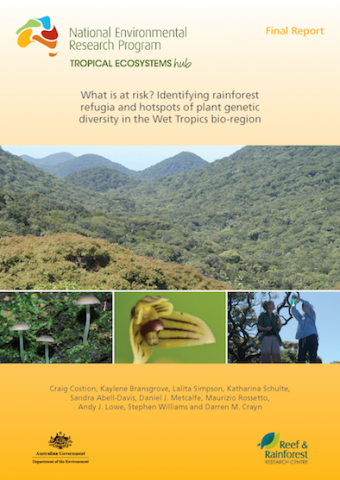 Costion, C., Bransgrove, K., Simpson, L., Schulte, K., Abell-Davis, S., Metcalfe, D., Rossetto, M., Lowe, A. J., Williams, S., Crayn, D. M. (2014) What is at risk? Identifying rainforest refugia and hotspots of plant genetic diversity in the Wet Tropics bio-region.
© JCU
Largent, D.L., Bergemann, S.E., Abell-Davis, S.E., Kluting, K.L., Cummings, G.A. (2013) Five Leptonia species from New South Wales and Queensland, Australia. Mycotaxon. 125, 11-35 [doi:10.5248/125.11].
Kooyman, R.M., Rossetto, M., Sauquet, H., Laffan, S.W. (2013) Landscape Patterns in Rainforest Phylogenetic Signal: Isolated Islands of Refugia or Structured Continental Distributions? PLoS ONE. 8(12) e80685 [doi:10.1371/journal.pone.0080685].
Crayn, D.M., Costion, C., Harrington, M.G. (2014) The Sahul–Sunda floristic exchange: dated molecular phylogenies document Cenozoic intercontinental dispersal dynamics. Journal of Biogeography. [doi: 10.1111/jbi.12405].
Largent, D.L., Bergemann, S.E., Abell-Davis, S.E., Kluting, K.L., Cummings, G.A. (2013) Three new Inocephalus species with cuboid basidiospores from New South Wales and Queensland, Australia. Mycotaxon. 123, 301-319 [doi:10.5248/123.301].
Costion, C.M., Edwards, W., Ford, A.J., Metcalfe, D.J., Cross, H.B., Harrington, M.G., Richardson, J.E., Hilbert, D.W., Lowe, A.J., Crayn, D.M. (2014) Using phylogenetic diversity to identify ancient rain forest refugia and diversification zones in a biodiversity hotspot. Diversity and Distributions. [doi: 10.1111/ddi.12266].

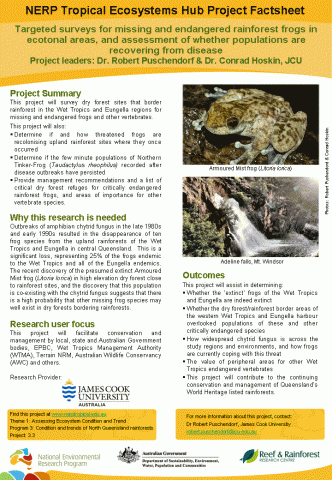 This project will survey dry forest sites that border rainforest in the Wet Tropics and Eungella regions for missing and endangered frogs and other vertebrates.
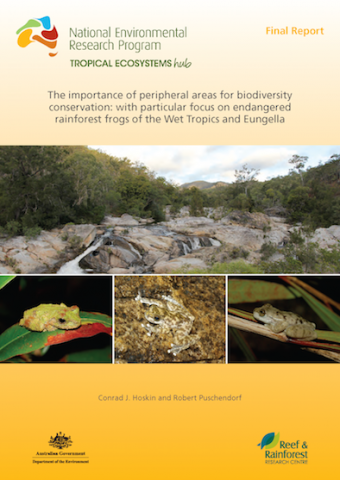
Hoskin, C.J., Puschendorf, R. (2014) The importance of peripheral areas for biodiversity conservation: with particular focus on endangered rainforest frogs of the Wet Tropics and Eungella.
© JCU
Pages
Latest News
- Laws protecting the Great Barrier Reef to be introduced next week, Queensland Premier says - Thu 28th May 2015
- Let’s get serious about protecting wildlife in a warming world - Thu 28th May 2015
- We’ve only monitored a fraction of the Barrier Reef’s species - Thu 28th May 2015
- Great Barrier Reef: warmer waters helping coral-eating starfish thrive - Fri 13th Feb 2015
- You are what you eat—if you're a coral reef fish - Wed 17th Dec 2014

Current search
Search found 254 items
- [all items]